top of page

Sharing our memories of Heald Green
Last Updated 26th September 2026

Etchells Primary School

By Helen Morgan

First Published 17/02/2026
Last Updated 17/02/2026
Our first council school. This is the history of the building.
To read the full history of Etchells School, click here.
The 1920s
By 1921 education was mandatory for 5-14 year olds. The age of compulsory schooling had been slowly going up since the Elementary Education Act of 1880 required children aged 5-10 to attend school to attain standards, before starting work! There were no schools in our village other than private ones.
In 1927 the go ahead was given to build Etchells School as a mixed school (like our primary and secondary together) for all ages up to 14. Legal difficulties were then encountered, which delayed progress until the Hadow Report of 1931 was presented. The school was then to be just a primary school and therefore the plans had to be changed causing further delay. Then the financial crisis hit and the Chancellor of the Exchequer stopped all government expenditure. The County Council did not want to burden the ratepayer and the scheme, although not scrapped, went into abeyance until financial conditions improved.
The population was estimated at 1250 in 1928 and yet by the 1931 census it had risen 72% to 2143, more than any other ward around. The argument that people were reported to be hesitant to come here, because there was no school, no longer held any weight. Heald Green was a lovely place to live. Indeed, it was stated as fact that our railway station was higher above sea level than any other station between Manchester and London, with breezes galore!!!
2
1
On 8th February 1929, in the Stockport Advertiser and Guardian, the Council Chairman stated, “The Cheadle and Gatley Urban District Council valued and received help in the cause of education by the sale of land at Long Lane to the Education Authority on generous and advantageous terms, with the desire to help forward the provision of new schools in the area.”
By this time an education subcommittee had sent recommendations to Cheshire County Council for their quick and earliest considerations and they were then sent on to the Board of Education. Now there was a wait for approval from a special subcommittee as to whether a primary school or a modern school (secondary) should be built......talk about red tape! There were many factors to consider including not imitating too closely what provision was already close by. However, the newspaper piece concluded “Long Lane was to be completed whatever the report. It would be called Etchells School.”
The 1930s
The Hadow Report in 1931 standardised what was expected of schools. Primary schools were to be split into infants for up to age 7 and juniors from 7-11 years of age. The curriculum was to be based on children’s knowledge and experiences. Primary schools were to be mixed but had to cater for boys and girls in games and physical education. Mixed schools were to employ an adequate number of male teachers. The needs of “specially bright or retarded children” (their words from their time), should be met by appropriate arrangements. School should offer what was essential to their healthy growth both physical, intellectual and moral, during this stage of their development. No primary school class was to have more than 40 pupils. (Remember that one for later!)
3
On 25th December 1931, again in the Stockport Advertiser and Guardian, Councillor Barsley announced “A new Finney Lane School” as “A red letter day for the district.” He had been asked by the school managers (called Governors today) to officially open the school on Wednesday January 6th, 1932, at 3.30pm. He declined but would preside over proceedings, leaving the honour to County Councillor, T A Edwards, Chair of the Cheshire Education subcommittee for Ashton and Stockport District.
The school would be open two days prior to that for inspection, and there were lessons that morning. The school had been built by Messrs L Brown and Sons Ltd of Wilmslow. They would go on to build the Methodist Church on Brown Lane in 1935.
The cost was £9700 and it was a single storey building. The site was 3 and a half acres and the land had cost £265. There was accomodation for 200 children, in four classrooms of 50 each (not 40!), together with “a commodious central hall.” This had a dividing partition to make extra accomodation for another 100 children. There were two staff rooms, store rooms and a kitchen that had facilities for heating meals. There was easy access to all rooms from an open veranda at the back and all the classroom windows opened onto this, thus giving a “semi open air effect.”

Fig. 1 The veranda in 1997, no longer open but with windows.
© Etchells School Archives
Click On Image To View
Mr Edwards proclaimed “It would be hard to find anyone who is more thrilled with joy and thankfulness than I am at the present moment. It has taken a long time but I feel grateful and I am satisfied, when I look at the building and think the children of this district will in the future, and for all time be adequately provided for with educational facilities, without the hardships they have experienced in the past.” He carried on “He hoped that the children who were to attend the school he was opening, would live to see the building being kept up to date with the needs of the neighbourhood and that sometime it might form a wing of a very large school.” Did he have a crystal ball!!
He ended with “Though the building was beautiful, the principal thing that concerned them was the education of the children and that depended upon the parents, the staff of the school, the managers and the children themselves. We want the school to build up a reputation that will keep for all time.” Momentous words indeed. He then formally handed over the school to the managers (governors). A warm welcome was given to Miss Dora Jones C.C.J. the Headmistress (she had come from Darton Mapplewell Senior Girls’ school) and her assistant Miss Myra Warr C.C.J. The Reverend Tyler Whittle seconded the opening and said the school would “form an epoch in the history of the district. All they wanted now was a similar one in Gatley!” Cheadle Etchells Council School was officially open. Those two ladies were the only teachers with 86 children on roll!
4
After the Easter holidays, the roll had increased to 93 and Miss Irene Dorothy Mayle C.C.J. arrived on April 11th, 1932, as a teacher. She would remain there for many, many years and would become the Headmistress feared by so many.
The Board of Education stated in June, that the school could accommodate 360 children. It recognised that 250 infants and juniors could be provided for but older children could also be provided for, if necessary, “in the present circumstances.” Therefore, children up to 14 could attend. This is only 6 months later! The need was great.
In November the school had to send desks, chairs and tables to Queen’s Road school and then more chairs to Marple, showing just how tight education funding was. This would later lead to not enough equipment at Etchells when the pupil population increased substantially.
Of course, as 1939 arrived after the Christmas holidays, no one then realised that life for children and adults alike was to change dramatically. Germany invaded Poland on September 1st and Britain and France declared war on Germany on the 3rd. However, at Etchells the school closed on 31st August until September 11th to follow evacuation plans. By the 11th, evacuees had already arrived in the village and school opened its doors to infants and juniors from Blackley Municipal school for morning lessons, as well as their own.
The 1940s
January 1940 brought very cold weather and snow. The toilets were frozen and there had been pipe bursts. Staff struggled to get into school as both train and bus services had been suspended. There were 159 children on roll but each day there were less than 100 attending. In June all gas masks were inspected by local air raid wardens. They had to be carried with you at all times, no exception. The air raid shelters were also inspected, so again had been built in the early days of the war.
On July 29th Dr Forde inspected all the children whose parents had signed for an overseas evacuation. This was for children to sail to “safe” Canada. Although once the Princesses Elizabeth and Margaret had decided to remain in London, the idea was not perceived as a good option.
In September 1940, there were still 156 children on roll but attendance was less than a 100, for morning or afternoon sessions, due to whooping cough doing the rounds. In December the air raid shelters were inspected again, after parental complaints and window protection was discussed. School hours were amended again to 9.30am-12 noon and 1.15-3.45pm. British cities were experiencing nightly raids by German bombers with London and Coventry being hammered in the “blitz”.
In December it was Manchester’s turn and on the 22nd and 23rd the sky lit up looking northwards to the city centre. On the 23rd bombs fell on Stockport too, including Cheadle. The war was getting very close to home. Can we really understand how frightening this must have been? Incendiaries were dropped to set places on fire and indeed one landed on the bowling green at East Avenue.
5
1941 and Britain was holding on. The Dunkirk evacuation had taken place and the Nazis were now only required to cross the channel from France and invade us, a mere 25 miles away from the south coast. The RAF had fought valiantly during the Battle of Britain over three months and three weeks up to October 1940. Many fathers of these school children were away fighting on land, sea and in the air. At Etchells, school life continued as normal as normal could be. Medical inspections continued and childhood diseases were endemic. The British Red Cross started to use classrooms after hours for lectures. Then on November 3rd, the air raid warning sounded from Beech House (where Tesco car park is now). Can you imagine four staff having to deal with over 100 panicking children?
In January 1942 upon the closure of the Church of England School in Cheadle, juniors and infants from Belmont Cottage Homes were admitted and classes were rearranged accordingly. Councillor Sharples gave a damming report on the general condition of the shelters, the grounds needed attending too and decoration of the whole school was due. However, the children’s work was a very good standard and their conduct was excellent.
By October 20th, a County Canteen Committee had decided to appoint a cook, Mrs Smith and an assistant Mrs Ash and on October 26th the school canteen opened. 77 dinners were served.
In March 1943 a member of the Ministry of Works called to inspect the iron railings around the school field. At this time all unnecessary metal was being removed and smelted down for the war effort. In October a man from the County Architects Department called to look at school having a nursery class and during November there were meetings to discuss enlarging the canteen.
By 1944 the war was turning in our favour and the D Day landings would take place in June. The anxiety from previous years must have started to turn towards optimism, but there was still a long way to go and many more lives would be lost. More meetings were held over a proposed nursery school.
1945 did not start well!! Children and staff returned on January 8th to find the school gates locked. The keys had been returned on January 3rd to the Clerk for the school managers and he had not been able to find a temporary caretaker. Staff and children were sent home. Then came Victory in Europe, celebrated with VE Day celebrations and school was closed for two days on May 8th and 9th. Reopening on the 10th with a Thanksgiving Service.

Fig. 2 Etchells School Victory Party 1945
From Heald Green in Wartime
Click On Image To View
In October 1947 a new canteen was opened after the half term holiday and Mrs Turrell was the cook with Mrs Connelly as a permanent canteen worker.
By the time of this photo of the canteen in March 1988 with the kitchen behind, it was shut and being held up with steel rods.
Fig. 3 Canteen and school entrance from East Ave 27/03/1988
© Etchells School Archives
Click On Image To View

In 1948 the school was inspected and this gives a useful insight to what was there and how and what lessons were being taught. This is a prese of the report that took place on February 4th.
“It is a one storey building of six classrooms and the usual ancillary accommodation. There is no hall, but the partition between two of the rooms can be drawn back to allow for one large room space for the morning assembly and other purposes and more advantage should be taken of this.
Kitchen and dining facilities were added in 1947 and are now serving midday meals for about 240 children daily. Numbers were less than 150 when the school opened. During the early part of the war, they were temporarily increased by the reception of groups of evacuated children. A permanent addition took place in 1942 when, subsequent to the closure of another school in the district, the children from the Boys’ and Girls’ Refuges Belmont Homes were admitted.
The number on roll is now 285 and the organisation provides for six classes, four of juniors and two of infants. In addition, there is a small group of less able children. The teaching staff consisted of the Head Mistress and seven assistants, including one awaiting admission to an emergency training college.
The teachers worked well under Miss Mayle’s regular and constant supervision and direction. Pupils are well behaved, mannerly and responsive. Their attitude during the religious observances which begin the daily programme, is one of quiet and reverent participation and their conduct and habits during the midday meal give evidence of effective social training. Three junior classes had a strong emphasis on the basic subjects in which work progress is satisfactory, in spite of a rather formal approach.
The attainments of Class 3 do not meet the same standards. The teacher is industrious and conscientious but so far has not been able to secure the best results from her class, which has proved to be a difficult one. Her control, though kindly, needs to be strengthened in order to ensure a more rapid rate of progress. The two classes of infants were well taught.
Small numbers of retarded (their words again) children are withdrawn from their normal age groups for the large majority of their lessons, to form a separate class which is taught in a small room by an untrained and inexperienced young man. This cannot be considered satisfactory and should be revised.”
At the end of January 1949, Browns Bros of Wilmslow delivered parts of the hut that would make a new classroom in the yard. After the Easter holidays, school opened with seven classes although there was no teacher yet for the new entrant class.
The 1950s
In June the new building in the yard was ready for use. Classes 7 and 6 were moved to the building followed by class 5, although the cloakrooms were not quite ready.
In July 1950, Class 1 was Mr Partington, Class 2 Mrs Cameron, Class 3 Mr Poole, Class 4 Mrs Suter, Class 5 Mrs Jones and Classes 6 and 7 were Mrs Stansfield and Miss Fowler.
In 1951 the first telephone was installed at the school on June 23rd.

Fig. 4 Mr Fells Class 1952-53
© P Jones
Click On Image To View
In February 1956 another school inspection took place. Here is the prese of that.
“Since the last report in 1948, three additional temporary classrooms have been built to accommodate an increased number of pupils. There are now 402 on roll, grouped in 9 classes, seven of which contain 47 or more children including three of 50. The difficulties of organisation are complicated by the uneven size of age groups, two of which are between 70 and 80.
Numbers have outgrown the cloakroom facilities and the school is still without a hot water supply. The staff consists of a Headmistress and nine assistant teachers, four of whom have been appointed in the last six months.
After 22 years’ service the Headmistress maintains her enthusiastic work on behalf of the children, loyally supported by her industrious colleagues, among whom there are young teachers of high promise. The recent introduction of another infants’ class has resulted in a shortage of equipment in the youngest classes, one of which is housed not too satisfactorily in part of the hall.
In the juniors, mental arithmetic is a daily practice. Living specimens are kept in some of the classrooms to stimulate the curiosity of the children. The lack of free space makes physical education largely dependent on fine weather. The school playing field still remains undeveloped.
Approximately 270 children have their midday meal cooked at school including 12 who bring sandwiches. The staff contend with many difficulties, most importantly of all, the overcrowding. That their efforts should have met with so much success is a matter of congratulations to all concerned.”
January 1957 began with a reorganisation of classes and an extra class was formed making ten in all. In 1958, when Miss Mayle was absent, Mr Partington became her deputy in charge.
By April yet another class for new entrants was formed. The new academic year in September opened with 13 classes and new teachers. On 27th October after half term, the 14th class was formed for 7-8 year olds. A third extension building was opened and put to use. In December proposals for a 15th class were put forward!!
This photo shows the dreaded toilet block being demolished in 1997. Some of original extra huts used as classrooms can been seen.
Who remembers Izal toilet paper......?
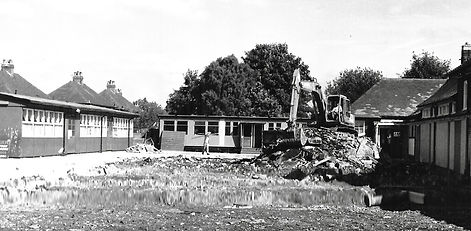
Fig. 5 Toilet block demolition 1997
© Etchells School Archives
Click On Image To View
In 1959, after the Easter holidays, 130 children were transferred out to Turves Road Primary School and 15 classes went down to 13.
The 1960s
The 1950s had been hard work for all the teaching staff but it was to get far worse. The population of Heald Green was expanding at a fantastic rate, as more families moved onto new housing estates being built. When school reopened in January 1960, they were back to 14 classes.
In January 1961 the school needed to accommodate another new entry class in the canteen. In February some classes had to be rearranged. Mrs Hollis took the new entry class in K classroom and the 7+ class transferred to the canteen with Mrs Britten. After Easter, Mrs Hollis and her forty two 7 year olds, started learning at Cheadle County Primary School. Mrs Bloor and her forty three 8 year olds, went to Styal Primary. At the same time there were 46 new admissions, a class in itself, and Mrs Austin was put in charge of this new entry class.
In December, Mr W H Ringham, Headmaster of the new Handforth Hall County Primary school was temporarily in charge of the school, as Miss Mayle had been absent since September, whilst preparations continued for his new school to open in 1962. The bad weather of snow and fog were playing havoc with getting children off site to the other two schools. Over the festive break, the hut containing classes 7A, 8A and the new 8B was internally decorated. Arrangements were made to put class 5B in the canteen with Mrs Fishwick. Furniture was sought and loaned from other schools.
In 1962, the roll was now 746!!
The day after, entrants not 5 years of age until the end of January, were also admitted! New equipment for the reception class at the new Handforth school was requisitioned for here instead. Towards the end of January, work began to re-asphalt the school drive and canteen paths.
February gale force winds caused havoc to the classroom huts, causing extensive damage to the roof and door hinges. In April it was announced that Mr Husband, the new Headteacher for the new Outwood Primary, would take over in May as Miss Mayle was still absent. On April 13th a letter was sent to inform parents that no under 5 entrants could be admitted next term.
Outwood School was not ready for occupation until after the beginning of the summer term. Classes were to be reorganised with the opening of Outwood and the subsequent transfer of children to it. It still left 14 classes at Etchells as follows:
1a Mr Partington, 1b Miss Frodsham, 2a Mrs Evans, 2b Mr Fell, 3a Mrs Hulme, 3b Miss Taylor, 4a Mrs Bloor, 4b Mrs Fishwick, 5a Mrs Jones, 5b Mrs Stansfield, 6a Mrs Auchincloss, 6b Mrs Williams, 7a Miss Woodall, 7b Mrs Peck.
In December Mr Doleman, visited school to meet the staff.
On March 1st, 1963 Mr Reginald Doleman took up his duties as Headmaster. There was no mention of what happened to Miss Mayle. No goodbye or leavers assembly for her. A rather sad ending really after being at the school since April 1932. The school was under immense pressure with the number of children there.
On December 21st 1963, Deputy Head Mr Frederic Partington retired after nearly 20 years’ service. He was presented with a tape recorder as a token of appreciation by the head, staff and children.
In January 1966, Mr John Bannister became the new Deputy Head. September started with 519 on roll, still a huge number of children when you think that Outwood and Prospect Vale Primaries were also open. In October the heating in two demountables was causing concern. Paper towels wiped over the desks showed considerable amounts of coke dust that had accumulated overnight. Plans were put in place to change to electric heating.
School opened in 1967 on January 6th, and Mr Doleman had been called out the night before to the demountables C and D, as the new electric heaters were not working. The fault was rectified so school could open the next day. On March 21st classes moved into NEW demountable classrooms (caravan section buildings). After Easter another infant new admission class was formed. The staff was now 13 plus 1 temporary teacher.
In January 1969, Mr Woodcock became the Deputy Head. On May 5th the school gate and railings had been hit by Heald’s milk delivery truck that had “run out of control.” In September 1969, 470 children were on roll.
The 1970s
After Easter 1970, another new class was formed. In September a talk was given to parents about decimal currency

Fig. 6 Etchells layout 1977
© George Hudson
Click On Image To View
In 1971 there is the most wonderful entry dated 15th February “Country changed to decimal currency and dinner money taken completely in old currency, i.e. 8s.9d. for five meals, for the last time.”
This is another cracker. February 22nd a tanker driver delivering fuel oil to the school caused approximately 50 gallons (yes that much) to overflow onto the tank room floor in the main boiler room. He had attempted to deliver 200 gallons more than the quantity ordered!!
Fig. 7 Oil chute in boiler house 15.9.2025
© H Morgan
Click On Image To View

Luckily the delivery was in the half term but when school reopened the heavy smell of oil remained. A letter of complaint was sent forthwith. In March, Manchester Tank Cleaners had to remove the excess from the floor.
In January 1972, Mr Woodcock went for an interview for the headship at Dean Row County primary and got the job commencing in April. On May 1st Mr David Baker took over as Deputy Head.
In 1973 on December 3rd the canteen was converted to North Sea Gas, crikey do you remember that in your own house?
School had a delayed opening until the 14th, due to a national fuel crisis in January 1974. Of course, this was the year later on of the three day week, caused by a shortage of electricity when power cuts became the norm. Miners were on strike and OPEC increased their prices. Heath’s Conservative Government imposed the three day week to conserve power, as coal was in short supply. I remember it well, do you? No telly at night and playing cards lit by a paraffin lamp and candles!!
On January 25th the last ever managers meeting to be held under the auspices of Cheshire County Council was held at High Grove County Infants school. As of April 1st the school was now under the control of Stockport Metropolitan District of Greater Manchester. On September 3rd a pre-school class was formed to commence on a half time basis for the time being.
At the end of July 1975, Mr Baker resigned to take up the headship at Ladybridge County Primary. Mrs Mary Anderson took Mr Baker’s position in September and then Mr John Bromley became the Deputy Head from January 1976.
In March 1976, a manager’s meeting was held and the state of the outbuildings was discussed and an architect visited a week later. In April the state of the floorboards in Miss Bentley’s room, D2 were causing concern. They were repaired by a joiner. Both Mr Doleman and Mr Fell continued to have frequent bouts of illnesses and absences and had been for a few years by now. In July the Director for Education visited to present Mr Doleman with a long service gift, as he had announced his retirement. On August 31st 1976, after 43 years of teaching, Reginald Doleman, Headmaster since March 1963, retired officially.
In September visits were made by heating inspectors as Block D continued to give cause for concern. In October temporary repairs were made to the roof of Block B. It seems the wooden buildings were becoming well past their sell by dates. A visit from an architect in November reported of immediate attention needed to Blocks B, C and D. From the roof to rotten windows/frames, floor movement, heating and gable ends. The roof of the main building would also need repairing. For now, only the heating would be sorted. In December there were many meetings with works departments to survey the maintenance requirements of Block B and C. Mr Bromley continued as acting Head until the end of the year.
In January 1977, Mr Keith Hayhurst began his duties as Headmaster. There was a staff meeting to clarify NUS/NAS action on class sizes over 35 and non-cover of absent teachers. In March discussions were held concerning the roof of Block B that needed re-felting and Block E needed protection from electric cables. New fire apparatus was also needed.
It was the year of the Queen’s silver jubilee and jubilee mugs were given out (do you still have yours?) School closed on 21st June, as the Queen was visiting Stockport (did you get to see her?) A school uniform was selected at parental request and a Parents Association was set up.
On November 30th Mr Fell officially retired after being offered early retirement. He had been absent since July. He had been a staff member for over 25 years, starting on 12th June 1951. He received a cassette recorder from the children, teachers and parents. At a manager’s meeting on December 9th, architects discussed future plans to extend the school buildings and do temporary repairs to the mobiles.
A survey was done in July 1978, to see if sinks could go into reception classes and in August £3000 was awarded to improve the infants’ toilets.
In April 1979 Mr Bromley was appointed the new Head at Outwood School. In May, Mr Alan Potter was appointed the new Deputy Head.
The 1980s
1980 began with the following teachers. Mrs Burns, Mrs Kinrade, Mrs Jackson, Miss Allen, Mrs Robinson, Mrs Riding, Miss Jones, Mrs Bagnall, Mrs Chapman, Miss Bentley, Mrs Dixon and Mr Potter.
In 1981 Mr Draper was interviewed and appointed as the new Deputy Head.
1982 was the golden jubilee for the school and there was a concert held in June to celebrate, along with a display up in school for four days. The whole school was being painted internally by Christmas and a new oil central heating system was to be installed in eight classrooms.
In April 1984, Mr Hayhurst was seconded to the Advisory Service for two years and so Mr Draper became the Acting Head with Miss Bentley as the Acting Deputy. On May 9th the NUT called a “day of action” and their members did not perform their duties, following nationally agreed union policy. Ten classes were therefore asked not to attend school that day.
There would be trouble ahead in 1985 with more strike action by teachers. Just before the Whit holidays, Mr Hayhurst was presented with a set of crystal glasses, as he had been made a permanent Education Adviser, therefore ending his seven years at Etchells. Miss Bentley became Acting Head. Mr Howard Fox was appointed to commence his duties in April 1986.
In January 1986 Mr Fox came for a look round in preparation for the following term. In Block B, Mrs Price’s B1 classroom, was creaking in strong winds. The architect assured that all was safe. On January 28th, 13 teachers went on strike for half a day as both unions, the NUT and the NAS, called action. The rest of the staff worked as normal. On February 27th there was another half day strike for 11 teachers. At Easter Mr Draper finished his two year period as Acting Headteacher. The summer term began on April 7th with Mr Fox as Head and Mr Draper as his Deputy. There were 377 children on role and the school was operating a two form entry. There was a special Governors meeting over the Whit holidays, as the Education Authority were bringing in a plan to reduce admissions from 50 to 40. Many parents had already objected to this. Mr Fox ended the school year with his personal entry “It is a friendly place with lots going on and I am sure that I shall be very happy here.”
September started the new academic year. Clubs and activities were to start up again because “the teacher’s dispute was in abeyance.” In October discussions were held at the Town Hall with 14 local headteachers about changing the local catchment areas. Etchells were now restricted to an admission limit of 40 per year group. Mr Patrick Draper was appointed the new Head for Outwood Primary from January 1987. The Deputy Head’s job was advertised but not filled as the school finished for Christmas.
1987 was the year the age of the building finally caught itself up. Mrs Shirley Jones became acting Deputy Head until Easter. Interviews took place and Mrs Susan Mosco from Brooklands School was appointed the new Deputy Head from the next term. The teacher’s strike continued.
Over the summer holidays Mr Fox had discussions relating to the condition of the HORSA kitchen building and dining room. They were found to be defective and the kitchen was not to be used again. The dining section was to be propped up as a temporary measure. Plans were proposed to eat in the hall and perhaps a kitchen could be created from one of the existing classrooms. All would have an impact on school life.
When children returned in September the hall became the dining room. Food was cooked at Outwood and sent over. An Educational Adviser came to view for himself the impact the building failure was causing. Whilst there, Mr Fox took the opportunity to also show him the old wooden classrooms outside and the toilet block. On September 17th, buildings B, C and D were looked at by the Works Division. In Building B, the support brackets and bolts were showing considerable signs of movement. In Building C, the windows needed fixing to verticals beneath. The load bearers in Building D were looked at and the crack in the chimney on the main building. The main toilets were draughty and the “sight” wall showed signs of lean and wear.
In October Mr Williams, Assistant Director of Education, came to look at the buildings and to discuss possible future plans. On November 24th at a Governors meeting, the Assistant Director of Education laid out the plans for a new hall and kitchen to be built and to return the present hall back into classrooms. The plans had been put forward to the Council, Education Committee and Department for Education. If this plan went ahead, a further extension could well take place to replace all the old temporary buildings within a few years.
This is March 1988 and the steel rods can be seen propping up the walls. Dinners were now served in the school hall for the time being.
Fig. 8 The support system is visible on the canteen 27/03/1988
© Etchells School archives
Click On Image To View

1988 began with 361 children in 13 classes. In May Miss Jennifer Godwin, a support teacher for those whose first language was not English, was called to assess the situation at Etchells. On July 22nd after lunch there was a ceremony to mark the retirement of Mrs Phyllis Riding after 22 years and 1 term. Presentations were made.
1989 would be the year of the new buildings with safety officers arriving and fences erected. By the end of January portacabins arrived. On February 6th building work began on the new hall/dining room.

Fig. 9 Canteen, garage and oil store 27/03/1988
© Etchells School archives
Click On Image To View

Fig. 10 Demolished area with B block on right 26/07/1988
© Etchells School archives
Click On Image To View
Fig 9 is taken from East Avenue Park, Fig 10 shows where the canteen and kitchen had been.
Below in Fig 11, Les the site manager, showed the Mayor and Mayoress of Stockport around the site of the new hall building on 21st April 1989. This was Councillor John Ashworth and his wife Christine. They placed a time capsule in a partly completed pillar on the left hand side of the entrance to the new hall. There is a brass plaque there now to commemorate this. Inside the capsule were objects chosen by the children to represent 1989.

Fig. 11 Les and Mayor and Mayoress Ashworth 21/04/1989
© Etchells School archives
Click On Image To View

Fig. 12 The time capsule April 1989
© Etchells School archives
Click On Image To View
The school archives have a number of photos of the building works.

The crane was 31.5m tall This did fall on its side at some point, apparently!
Fig. 13 The crane March 1989
© Etchells School archives
Click On Image To View

Fig. 14 The timber roof June 1989
© Etchells School archives
Click On Image To View

Fig. 15 The foyer into the hall 1989
© Etchells School archives
Click On Image To View
With all this building work going on school life continued. The hall, entrance hall and kitchen were progressing and it was hoped they would be ready by the October.

Fig. 16 The teaching staff around 1989
© Etchells School archives
Click On Image To View
The photo above may well have been taken in 1989 as it was with all the phase one photos. Mrs Mosco, Mr Harrison and Miss Bentley all left in July 1990 and in 1989 Mrs Burns was on secondment, so was not on this photo. Ex-pupils have done their best to name all these teachers.
Top Row L-R Mrs Bottomley, Mrs Clarke (many thought this was Mrs Riding but she retired in July 1988), Mrs Bagnall, Mrs Coulby, Miss Jones, Mr Harrison, Mrs Hohne, Mrs Lee and Mrs Pettifer.
Front Row L-R Mrs Edmonds, Mrs Chapman, Miss Bentley, Mrs Wood, Mrs Mosco, Mrs Harrison the school secretary, Mrs Proctor and Mrs Keeling.
In September the new National Curriculum started with new names for classes. Reception was still that. Middle infants became Year 1, Top infants became Year 2, first year juniors became year 3, second year juniors became Year 4, third year juniors became Year 5 and fourth year juniors became Year 6.
The new curriculum began with year 1 and would then progress with them through the years moving forwards. Section 11 teachers visited to look at provision for children whose language was not English first. Miss Anna Hiett would now work with these children on a half day per week basis.

Fig. 17 From East Ave park 01/11/1989
© Etchells School archives
Click On Image To View
Fig. 18 Completion, from the front 1989
© Etchells School archives
Click On Image To View

In October, it was hoped that the handing over of the new hall complex would happen very soon. School closed for half term in the knowledge that upon returning, the new building would be ready for use. The “old hall” was to be converted into two permanent classrooms. On October 31st the first assembly was held in the new hall and dinners were once again prepared on site for lunches.

Fig. 19 First meals served from the new kitchen 31/10/1989
© Etchells School archives
Click On Image To View
The 1990s
In March a large group from Stockport Education Committee called to view the new building work. They also saw that the “old hall” had been converted into two classrooms and saw the state of the four “temporary wooden” classroom blocks in the yard.
Miss Bentley left at the end of term after 16 years and 1 term. Her contribution to arts and crafts and dramatic productions was praised. Mr Harrison retired. Mrs Mosco also left after three years.
September 1990 began the new academic year with a spare classroom!! It was set up as a constructive play area with a theme of journeys, so it had a garage, travel agency and spaceship in it. It was hoped even the quieter children would join in there.
The Special Educational Needs (SEN) department of the Town Hall came to visit, with the prospect of Etchells becoming a “resourced school” for SEN children. Interviews were held for the Deputy Headship and Mrs Lyn Holebrook was appointed from January 1991. In November the school held a meeting to talk about concerns for competitive tendering for school grounds.
Storm damage happened on 9th January 1991. A large section of the roof from Block D, measuring 40ft by 8ft, had lifted and landed on and near Block A, causing overhead power lines to break also. Windows had been smashed. Eight classrooms were without heat or light and classes had to be moved around to accommodate each other.
Whilst repairs were taking place the same day, Mr Fox was keen to show the effect on Block B where the wall ties were under considerable stress. Power was restored to Blocks B and C to get five classrooms back in use. By 1.30pm the roof was being repaired and broken tiles replaced. The wind was getting up again, although not storm force like it had been. Mr Fox was advised that during high winds, Blocks B, C, D and E should be evacuated along with the junior yard.
In the interim, Block D with its three classrooms, three stockrooms and a cloakroom was to remain unused. The assistant Director assured Mr Fox that remedial work and other investigations would be done quickly, meaning that all the buildings would be available within a few weeks.
There is a contradiction in the size of the roof piece in this article, but still very dangerous all the same.
Fig. 20 Roof off in winds
Stockport Express Advertiser 23.1.1991
Click On Image To View

1992 was a significant year, as it was 60 years on January 6th since school opened. In March it was also announced that Etchells would become a “Resourced school” for children with SEN in September. All staff went on visits to Overdale, to have a better understanding of this role ready for September. Personnel from the Department for Education came to look at the state of the buildings. On July 23rd Mrs Chapman, after 16 years of being on the permanent staff, and being on and off a teacher there since 1958 retired.
Over the August holidays, changes were made to some school buildings in readiness to take SEN children in the Resourced School. A handicapped toilet area with changing and bath facilities was created near to the hall. The “old staffroom” became the withdrawal room. A new staffroom was created from a former classroom with hot and cold water, carpet and electrical sockets fitted. The car park was also extended.
In September Mrs Edmonds started in her lead role for the Resourced School Unit with Mrs Keeling, Mrs Frost and Mrs Williamson assisting her. The unit opened with four children, one who had already been at Etchells for three years. The concern for Blocks B and D was again expressed to structural engineers. In December Councillor Ann Doherty called to see the Resourced School in operation and viewed Blocks B, C and D which were being considered for strengthening.
School reopened in January 1993 and the problems of the wooden outbuildings was first on the agenda. They were considered to be unsafe in heavy snow or high winds. It led to Mr Fox writing to the parents to bring them up to date concerning their children’s safety. Should bad weather lead to the evacuation of Block B, then Mrs Bottomley’s class would use the drama room and Mrs Holebrook’s would go to a room in Block E. The infant toilets, the yards and access to Block C were still deemed to be safe. A more comprehensive letter went out to all parents.

Fig. 21 School map 07/01/1993
© Etchells School archives
Click On Image To View
The condition of the buildings was being monitored by the Local Authority. At this time Block B was the music room, Mrs Holebrook’s and Mrs Bottomley’s classrooms along with the infant toilets. Block C had the classrooms of Mrs Lee and Mrs Proctor. Block D had the drama room, Mr Toft’s classroom and Mrs Boulton’s. Block E was the caretaker’s storeroom along with Mrs Coulby’s room that included cookery.
Security and strengthening were to be undertaken over the next few weeks. If a dire emergency arose, the schools of Outwood and Bolshaw were ready to provide accommodation. On 11th January Block B was evacuated due to high winds and again on the 12th. The Stockport Express went to cover the story.
There was a site meeting on the 13th and it was agreed that Block C would be strengthened first. On Friday 15th, with wind gusts in Heald Green expected to reach 60mph, Blocks C, D and E were evacuated. Granada TV and the BBC sent camera crews. On Thursday 21st January again the blocks were evacuated. There followed a very windy weekend and parents were concerned whether the blocks were safe for their children. Later that day, they were inspected by an architect and structural engineer and pronounced safe.
Over the February half term, Block B had remedial work carried out. On returning after the holiday, Block B was still out of use, although the toilets could be used. On February 26th Tim Tarrant from the Department of Education from London came with an assistant to look at the blocks. He emphasised the high pupil number, determined by a government formula based on the number of classrooms but spoke about spare classroom spaces that were available in our area. A reduction in classroom numbers was “suggested” as the way forward!!
In May 1994, Mrs Holebrook became Acting Head whilst Mr Fox was absent. In July representatives from the Building Section and the DFE came to look at the outside buildings again! At the leaver’s assembly in July, goodbyes were said to Mrs Bagnall as a full time member of staff, having given 15 years’ service to the school, choir and band. She would return in September part time.
In September there was an initial visit to look at re-wiring the main building. Mr Fox was still off with Mrs Holebrook as Acting Head.
In January 1995, it was announced that Mrs Holebrook would remain as Acting Head until Easter. She would remain as Headteacher until 2011, with Mrs Lee as her Deputy, and Phase 11 happened during her time there.
The school logbook, the font of all this knowledge, came to an end there unfortunately.

Etchells big tree can be seen on the right along with Block C on this photo.
Fig. 22 V E Day 50th anniversary celebrations 1995
© Etchells School archives
Click On Image To View
Fig. 23 SEN pilot scheme
Stockport Express Advertiser 22.11.1995
Click On Image To View

At long last it seemed that the school was going to be renovated and the outdated wooden structures would be removed.
The disruption for children, staff and parents must have been off the charts, as school life had to continue and work around what was happening. Over the months the main corridor would be boarded up, the toilet block demolished, the wooden outbuildings (apart from Block C) demolished, new classrooms, a new nursery and staff room built, a new bigger playground, landscaping.......
Demolition began on 28th July 1997, as soon as the summer holidays began.

Fig. 24 Demolition 04/08/1997
© Etchells School archives
Click On Image To View

Fig. 25 All gone 26/08/1997
© Etchells School archives
Click On Image To View
In September school reopened for the autumn term.
Foundations were dug in September. In October the first bricks were laid and the library was packed away

Fig. 26 Building a temporary corridor August 1997
© Etchells School archives
Click On Image To View

Fig. 27 First laid bricks October 1997
© Etchells School archives
Click On Image To View
Classrooms began to take shape and by November the roof was going on.

Fig. 28 Classrooms taking shape October 1997
© Etchells School archives
Click On Image To View

Fig. 29 Roof going on November 1997
© Etchells School archives
Click On Image To View

Fig. 30 New classroom April 1998
© Etchells School archives
Click On Image To View
Work then began on demolishing the old wooden “temporary” buildings in May 1998.
.jpg)
Fig. 31 Demolition May 1998
© Etchells School archives
Click On Image To View

Fig. 32 Demolition May 1998
© Etchells School archives
Click On Image To View
From Easter to July 1988 the new car park was the playground.
Fig. 33 Playground from Easter to July 1998
© Etchells School archives
Click On Image To View

By July the new playground was being laid.

Fig. 34 Preparing new playground July 1998
© Etchells School archives
Click On Image To View
The new nursery was being prepared for its September 1998 opening.
Fig. 35 New nursery July 1998
© Etchells School archives
Click On Image To View

At long last the rebuild was complete and ready for the academic year of September 1998.

Fig. 36 Ready for September 1998 intake all sch under one roof
© Etchells School archives
Click On Image To View
Over 1999 and 2000 the school grounds were improved and landscaped. As you can see in the next photo, block C remained as the infant’s classrooms.

Fig. 37 Landscaping 1999
© Etchells School archives
Click On Image To View
Into the 2000s
By September 2003, a new Early Years Hub had been built. Teachers worked tirelessly over the October half term to move everything from Block C or “The shed” as it was known. Infant classes returned after the holidays to a brand new space, still used today.
Fig. 38 Early years hub 01/10/2025
© H Morgan
Click On Image To View

Block C was demolished over November and December 2003. The school continued to reinvent itself, moving forward and adapting to the needs of their children.
In October 2015 new classrooms were added for the top junior classes.

Fig. 39 Year 5 mobile classroom 01/10/2025
© H Morgan
Click On Image To View

Fig. 40 Year 6 mobile classroom 01/10/2025
© H Morgan
Click On Image To View
Outside nursery equipment has been added.
Fig. 41 The nursery 01/10/2025
© H Morgan
Click On Image To View

There are play areas all around the outside space as well as a huge playing field.

Fig. 42 The play area 01/10/2025
© H Morgan
Click On Image To View

Fig. 43 The play area near the nursery and memorial garden 01/10/2025
© H Morgan
Click On Image To View
Inside is light and bright.

Fig. 44 Main corridor in main building 01/10/2025
© H Morgan
Click On Image To View

Fig. 45 Hall interior 01/10/2025
© H Morgan
Click On Image To View
The classrooms in the old hall retain the old windows, although not the high ceilings. The following photos may take you back!!

Fig. 46 Old Hall 10/09/2025
© H Morgan
Click On Image To View

Fig. 47 Old Hall 10/09/2025
© H Morgan
Click On Image To View

Fig. 48 Old Hall 10/09/2025
© H Morgan
Click On Image To View
Mrs Holebrook retired around 2011 when Mrs Jo Mallinson took over as Acting Head until Mrs Cathy Beddows arrived in January 2012. Mr Pete Cope became Acting Head for around 18 months or so and then in September 2025, Mr Stuart Kelly arrived. Ironically, he is an ex-pupil, who has now returned to his primary school that he has many happy memories of.
I spoke to him recently and asked him to give me an ending to this mammoth article.
“Etchells Primary has been at the heart of this community for nearly a century and remains so today. It is a fabulous place to work with great staff and very friendly families. We are incredibly proud of the roughly 400 children who attend. We are proud of their manners and their work ethic, proud of their very impressive academic results and proud of their extra-curricular achievements. Most of all though, we are proud of the way in which they help to make Etchells such an inclusive community, one in which the children with a range of SEND needs from our Resource Base thrive alongside pupils who grow up understanding and respecting difference and one in which diversity of religion, language and heritage is celebrated. The school is highly regarded in the community and will hopefully still be preparing the children of Heald Green and beyond for bright futures for at least another 100 years.”
- Stuart Kelly, In conversation 2025

Fig. 49 Stuart's class photo 1980s - can you spot him?
With thanks to Stuart Kelly
Click On Image To View
Stuart is third row up, fifth from the right.

Fig. 50 The school logo
© Etchells School
Click On Image To View
A big thank you to everyone who has given me their memories to share in the full version of this article. Unbelievably this is an abridged version. The full version has all your memories, more photos, more teacher’s names, school trips, sporting achievements ... I have only scratched the surface of things that were recorded.
I am bound to have left out a favourite teacher, a specific trip or holiday, and all the events that the Parents' Association have organised over the years raising huge amounts for school resources.
Not forgetting the charity events to raise money for lots of different causes. The meetings held at school and the days it was used for local elections, European elections, Polling Day to change the government, area committee meetings, meetings to discuss “save our Bruntwood Park”, “Stop the second runway”, megastores being built.......
Bibliography
-
Stockport Advertiser and Guardian 8.7.1932
-
Stockport Advertiser and Guardian 6.1.1932
-
Hadow Report 1931
-
Stockport Advertiser and Guardian 8.1.1932
-
Heinekey, J, (1996) Heald Green in Wartime, pp.32
Search Our Museum Library (Google Drive account users only)
Timeline
Can You Help Us Improve The Museum?
-
Do you have any related personal memories, photos or documents that you can share with us on this topic?
-
Are any of our facts incorrect?
-
Contact us at healdgreenheritage@gmail.com, or via our Heald Green Heritage Facebook Page.
bottom of page