top of page

Sharing our memories of Heald Green
Last Updated 21st October 2026


By Helen Morgan

First Published 22/03/2026
Last Updated 13/10/2026
Cheadle Royal Laundry
The laundry and some of the houses around it.
.jpg)
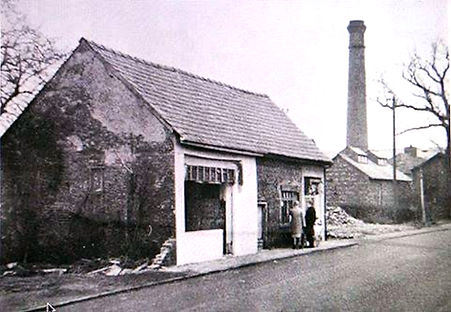
Fig. 1 Heathcotes and Cashs date unknown
© Graham Gill
Click On Image To View
This is one of the photos that set me off on this heritage project. I have no idea of the date unfortunately. In the foreground is a barn that was converted into shops and stands where the shops are alongside the Catholic Church now. If the shop on the far end is a sweet shop, then it is pre 1940. The area around the barn looks like a knocked down wall and a pile of bricks, so perhaps the shops were just taking off in the late 1930s??
I find it quite incredulous that this is Finney Lane. To me it could be somewhere in Manchester or Salford, not Cheshire countryside. In the background is Cheadle Royal’s laundry building, complete with large chimney for the boilers used to heat water there. This is now Troon Drive on the Gleneagles Estate.
In 1839, plots 347 and 346 and land north of it, were owned by landowner Joseph Anderton. In April 1867 William and Ann Anderton, and Benjamin and Ann Latchford sold the land. Joseph Holland, a surgeon from Prestwich, became the beneficial owner. Was he connected to the asylum?
In January 1887 Joseph Holland sold this land to the asylum for £1000 (roughly £170,000 today). Contained within the sale were dwellings and buildings occupied by farmer Macdonald. I believe that these houses were Yew Tree cottage and a house set further back with an orchard.
Fig. 2 Tithe map 1839, plots 347 and 346
© Cheshire Tithe Maps
Click On Image To View


Fig. 3 Conveyance Deeds from 1887
Courtesy of L Threadgold
Click On Image To View
Fig 4 is c.1897. Holly Cottage is not the one on the corner of St Ann’s Road North now, but the cottage that stood to the left of the shops in Fig 1. Yew Tree cottage would be on Finney Lane in front of where the laundry would be built. The house to the right of it was still there. (These two houses may well have been painted white and are recalled later on.)
Fig. 4 Map from 1897
© Ordnance Survey
Click On Image To View

“Re. the laundry at Cheadle Royal, my grandmother, Annie Ritchie, came down from Peterhead in 1900 to work in the laundry. She lodged with the Clancy family in one of the cottages on Bradshaw Hall Lane. Elizabeth Clancy also worked in the laundry, as did Annie Blockley who also lodged in one of the cottages. Sorry I can't give any insight into the laundry, as my grandmother died young aged 38, after having 7 children. Cheadle Royal drew on employees from all over the UK and Ireland.”
- Mick Hankinson, Facebook 2026
So now we know that the laundry was there by 1900, perhaps it may have been earlier still? According to the Williams’ book, Long Lane Cheadle Remembered, around 1857 there were 17 staff at Cheadle Royal, of which four women were doing laundry and hall duties. However, by 1890 there were nearly 300 staff managing a huge estate in a self-sufficient way. Their laundry, let alone the patients', must have been done somewhere.
Elizabeth Clancy is on the 1901 census, married aged 28 from Liverpool. No occupation was recorded. Living with her were her children. 5 year old Nellie, 1 year old John and baby Rose who was 6 months. Annie C Ritchie, single aged 22 from Peterhead in Scotland, was their boarder and a laundress.
Annie Louisa Blockley another laundress, aged 26 from Hulme, was living in another cottage on Bradshaw Hall Lane. It was the home of Ruth Sutton, a widow aged 42. Her occupation was recorded as chapel keeper, so perhaps she had something to do with Long Lane Chapel? Her son Joseph was a coachman aged 24, and they lived with another boarder, James Albert Dwyer who was an agricultural labourer. Neither homeowner had a connection to Cheadle Royal at that time, so perhaps the cottages they were in were not owned by Cheadle Royal, unlike other houses around?
However, as Mick says, Elizabeth Clancy did work in the laundry at some point. On the 1901 census also, John Gaines, aged 26 from Liverpool was an engineer and boiler attendant, living at Yew Tree Cottage with his wife. They too had a boarder, Ellen Gulson aged 27 from Lincolnshire. Her recorded occupation was laundry superintendent. He was still there in 1903.
1

Fig. 5 Map from 1907
© Ordnance Survey
Click On Image To View
Fig. 5 is c.1907 and the laundry building can be seen behind Yew Tree cottage. It seems there was a way from the Cheadle Royal estate to the laundry, for the washing to be delivered and returned.
I found the advert below from 1907. The applicant would live in Thorn Lodge, the old house at the top of East Avenue now.
Fig. 6 Advert for steward for farm and laundry Manchester Courier 1.6.1907
Click On Image To View


Fig. 7 Cows on Finney Lane roughly opposite West Ave 1920s
© Cheadle Civic Society
Click On Image To View
Fig. 7 shows the back of the house as the cows leave Cheadle Royal’s farm to graze in fields where East Avenue is now.
Fig. 8 Thorn Lodge Finney Lane 1979
© Helen Morgan
Click On Image To View

Thorn Lodge was built in 1751 and rebuilt in 1907, so ties up nicely with the expansion of the asylum. I believe that this was a Finney farmhouse originally, surrounded by many fields that belonged to them. It was Joseph Finney that would sell large swathes of his land to Manchester Royal Infirmary to build their asylum on by 1848. He was the owner occupier of this house in 1839.
By 1851 the Finney family had moved to Hope Farm, where Roseacre Drive is now. This house would become the home of superintendents or stewards for Cheadle Royal farm and laundry. By 1901 the house name “Thorn Lodge” appeared and was the home of James Armstrong who was an assistant steward.
In 1921, 44 year old William J Barsley and his wife Dora lived there. He was recorded as a hospital steward. He would become a very influential school manager (governor today), for Cheadle Etchells when it opened in 1932. They still lived there in 1939 along with a housekeeper, Lillian McLean. He was also the Air Raid Precaution warden for the hospital.
“This house was the farm managers with the farm buildings at the rear. The farm work was done by horse drawn vehicles, apart from when threshing took place and an outside contractor visited each year with a Field Marshall single cylinder tractor and a belt driven threshing machine, plus baling machine making straw bales. There were about 6 working shire horses plus a smaller cob type, that only delivered the farm produced milk to the various buildings. The farm milked about 12-15 cows. The milk round was always done by Mr Nixon with the cob, which was not as docile and placid as the shires.”
- Phil Jones Facebook 2021

Edith Chesters, a laundry maid, gave evidence about a nearby accident as recorded in the Stockport Advertiser and Guardian on 10th April 1908.
Fig. 9 Laundry maid evidence 10.4.1908 Stockport Advertiser and Guardian
Click On Image To View
On the 1911 census for Cheadle Royal staff, widow Hannah Ginger aged 59 from Gatley was the head launderess. I am assuming she lived at Yew Tree cottage along with householder Margaret Ginger, who was on the 1911 Slater’s directory at that house.
During WW1, laundry girls held a social evening to raise funds.
Fig. 10 Laundry girls' social 12.11.1915
Alderley and Wilmslow Advertiser
Click On Image To View

By the 1921 census, Yew Tree cottage was known as 62 Finney Lane and had five rooms. John McKreel aged 45 from Accrington and his 43 year old wife Alice, both worked for the laundry. They lived at their house with 14 year Mabel and 11 year old Florence.
In 1921 there was a catastrophe!

Fig. 11 Laundry water muddied 1.6.1922
Stockport County Express
Click On Image To View
I hope the laundry maids also had a chance to see Prince Henry, the third son of King George V and Queen Mary. He was on his way to unveil Stockport’s new war memorial and he passed by Cheadle Royal on Wilmslow Road.

Figs. 12a & 12b Prince Henry visit 16.10.1925
Alderley and Wilmslow Advertiser
Click On Image To View

Yew Tree cottage and the other house set back from it, may have been painted white, like other Cheadle Royal houses still on Finney Lane today, as they were recalled in Anne Rushton’s memories for St Catherine’s Linkline magazine. I do not think she is talking about the Moss Bulldogs semis, as I doubt they were ever white and Mr Stemp’s front garden there in 1939, was only a small one.
Fig. 13 shows plot 346 from Cheshire Tithe maps for 1839 superimposed onto what is there now. The house that stood there would have had a huge garden! I believe that Anne is recalling Yew Tree cottage and this house in her memory below.
Fig. 13 Map of plot 346
© Cheshire Tithe Maps
Click On Image To View

From the old barn that was a set of shops (now Christ Church shops).
“Moving down Finney Lane towards Wilmslow Road there were 2 more white houses, the second one being occupied by the Stemp family. Mr Stemp could often be seen working in the fields with horses. He always wore close fitting leather gaiters from ankle to knee. The house had a long front garden with a fence dividing it from the field next to it, on which he grew runner beans which formed a hedge of scarlet flowers in the summer. This field went down to the White House and onto the farm with a gate into its yard (Thorn Lodge), opposite East Avenue.”
- Anne Rushton, St Catherine’s Linkline magazine

Fig. 14 OS map 1934
© National Library of Scotland
Click On Image To View
This is a map from 1934 ish. I say that because Anne’s memories above are from the later 1930s. The laundry had extended massively around 1931 and the chimney stack was recorded, but it must have been there far earlier, as there was no hot water.
To the right of it now stands the Moss Bulldogs semis that became 32 and 34 Finney Lane (the numbers would later change again!) Yew Tree cottage is no longer recorded, nor the house that stood back from it. Perhaps they were demolished to make way for these semis?
Fig. 15 Moss Bulldogs 24.3.2024
© Helen Morgan
Click On Image To View

Now 100 and 102 Finney Lane. I call these houses Moss Bulldogs, due to the house plate on number 100. I have been told that a doctor who lived there bred dogs....
“True, offered my mum a pup, she used to talk to him on the way to the shops.”
- Shirley Slack, Facebook 2021
In 1939, Cheadle Royal workers still lived at Moss Bulldogs. The one on the left was for 65 year old Samuel Ratcliffe, a laundry washerman and his wife Sarah. The one on the right was for 38 year old James Stemp and his wife Esther. He was recorded as a Cheadle Royal gardener.
“Mr Stemp was the head gardener. He always wore a trilby hat, an apron and rode a big bike.”
- Walter Slack, in conversation 2025
According to the Williams’ book, Long Lane Cheadle Remembered, “Mr Stemp was well known in Long Lane as the expert who would willingly advise gardeners which apple trees to plant together to ensure pollination, or how to prune any tree or shrub.”
2
“The one on the right, 100 Finney Lane. I was six when I moved there, we stayed until I was 11, 1966-71. My dad worked the grounds of Cheadle Royal. The cottage was a tide cottage and when the grounds of the hospital were sold for development we had to leave.Mr And Mrs Jackson lived next door. Mr Jackson was also a groundsman.
The priest at the Catholic Church next door was Father Magowan, his housekeeper was Mary Dooley.
Across the road lived a man who played for Bolton Wanderers his name was John Hulme. His wife was French and they had a son called Dominic.
The laundry you talk about was disused when we lived there. We used to put on little shows, as it had what we called a stage. There was a rough path we walked down to get to the back, it ran next to the Jackson’s house. I think it was cobbled, but roughly as in there was grass growing among them. In reality it was where vehicles reversed up to empty the laundry. I used to love the tip, where they used to deposit all the unwanted plants, as they replanted the grounds. Got my nana a few lovely plants from there. As you walked from the laundry to the right, at the back of the houses and church, you would see the greenhouses where plants and veg were grown.
The houses along Finney Lane up to St Ann’s Road and up the opposite way to the chip shop, housed doctors and people who worked at the hospital. It was a lovely community. We used to have a box of fruit and veg delivered to our porch, which was in the back of the house, every Thursday.
I went to school on East Ave. Mr Dolman was the lovely headmaster, Mrs Morley, Mrs Bloor, Mr Fell, Miss Wheat, Mrs Jackson were some of the teachers there. Garth Snape, our local Bobby used to sometimes act as crossing warden when the lollipop man/woman was not there. I used to run to him, and he would pick me up and swing me around. His son Andrew was in my class at school. I recently drove down Finney Lane, it was similar in places but very different in others. I lived there in the best of times, lovely memories.”
- Chris Parkes, Facebook 2026
“I do remember in the 1970s onwards Mac and William shared one of the semis. Both guys were employed as concierges in reception at the main building. Both wore morning suits with striped trousers whilst working. I remember Mac being employed at the hospital in the late 50s and must have completed 40 years’ service in this role. Both absolute gentlemen.”
- Phil Jones, Facebook 2021
“What lovely men they were. I was told William was a Japanese prisoner of war.”
- Ann Park, Facebook 2021
“I remember William and Mac; the concierges dressed in morning suits. They were so kind and professional and treated all staff with respect, no matter what their status.”
- Lynda Raglan, via text 2026
On the 1939 register, at what was then number 94 Finney Lane (third house from the right below), lived 45 year old Lizzie Campbell, another laundry worker. Later on, she would become the laundry supervisor and live in the left hand side of Moss Bulldogs.

Fig. 16 The four white homes 24.3.2024
© Helen Morgan
Click On Image To View
Cheadle Royal workers were tied to the houses given to them through their jobs. If you left or retired through injury or old age, you had to move ... end of. The council houses on West and East Avenue and Rosslyn Road were built not solely to help workers move on, but it was a contributing factor.
There were regular adverts for different jobs at Cheadle Royal, placed all over the country and closer to here. A uniform and laundry were part of the package.
3

Fig. 17 Assistant matron post 30.1.1934 Yorkshire Post and Leeds Intelligencer
Click On Image To View
Fig. 18 Housemaids required 22.1.1938 Wellington Journal Shropshire
Click On Image To View

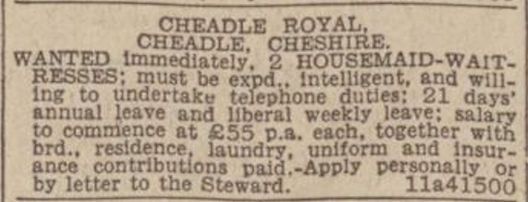
Fig. 19 House maid waitress
Liverpool Echo 11.8.1941
Click On Image To View
Fig. 20 Male nurses required
Liverpool Echo 6.9.1941
Click On Image To View


Fig. 21 Cooks wanted
Daily Dispatch 3.8.1945
Click On Image To View
Fig. 22 Laundry jobs nurses home
Stockport Advertiser and Guardian 11.1.1952
Click On Image To View


Fig. 23 Laundry machine operator
Manchester Evening News 28.12.1955
Click On Image To View

Fig. 24 Laundry worker
Manchester Evening News 6.1.1956
Click On Image To View

Fig. 25 Laundry job
Manchester Evening News 27.3.1956
Click On Image To View

Fig. 26 Laundry maid wanted
Manchester Evening News 27.11.1958
Click On Image To View
That was the last advert I could find. The laundry would be closed by 1959.
Of course, there are no more censuses to look at going forward in time. However, I have had the absolute privilege of speaking to a lady who actually worked there.
“I worked there with my mum before 1957 when I got married. The washing arrived daily from Cheadle Royal in a horse drawn van. George Nixon, no relation to the farmers, used to deliver the milk to Cheadle Royal and then take the swill to the pigsties. He would then bring round the laundry. We washed everything from patient’s clothing and bedding to staff uniforms that came with the job.
It was like the Charles Dickens era. There was no hot water, so the boiler had to heat it all and then we carried bucketfuls where needed. The boiler man kept the water hot and there were about 10 women doing the manual work. We washed and scrubbed using poshers and wash boards and removed items from very hot water with wooden tongs. We then had to rinse everything before water was removed by passing the items through mangles. Washing went onto ceiling racks in the drying shed, lifted and lowered using ropes and pulleys. The sheets were done separately in big washing machines and were then put on large, heated rollers to dry. We had aprons and stood on flag floors. Maggie Pickford had the worst job of washing the dirty, soiled stuff in the dry house.
The gas irons were attached to the ceiling by pipes and were lit underneath through big holes in the plate. The place was a hive of constant activity.
Lizzie Campbell was the laundry manager and lived in the left hand house of the Moss Bulldog semis. She literally walked down the side of her house, through a gate and she was at work. She was only a little woman but was tough and ruled with a rod of iron.
I worked there for about a year, saving up to get married. Cheadle Royal were well known for being good employers and paid the staff well. When the laundry closed and moved to where the old boiler house was on the Cheadle Royal site, mum continued to work there. Prior to that the old chimney there had just provided heat for the hospital.”
- Shirley Slack, in conversation 2023 and 2026
In September 1957 the Catholic Church bought a plot of land from Cheadle Royal for £1500. Up to this point the weekly mass was being held in an upstairs room at the Heald Green Hotel. This room was full and the landing and staircase was also being used! A new venue needed to be found and quickly. Father McGowan was appointed as the first parish priest in July 1959.
His first thought was for the church to buy the now closed laundry building. The condition of the chimney, boiler house and drying shed, all built far earlier than the main 1931 building, were however in a sorry state. A survey was carried out to see if the building could be adapted. The report read
“In our opinion the existing building could be immediately adapted to overcome the present difficulties existing prior to the erection of a new parish church. The general fabric and the roof of the main building are in remarkably good repair. With very little work and expense, seating for approximately 350 people would be immediately available. When the new church is completed, the building would make an ideal permanent centre for parish activities. However, the boiler house, drying shed and chimney, erected earlier are not in such good condition.”
Room for 350 people gives us some idea of the actual size.
The cost of the building and its freehold was estimated at £7500, before any building work could be carried out to adapt the building and demolish the chimney. The scheme was abandoned. The original plans were altered to move the presbytery forward, to give room at the back to build a church hall, that still stands today.
This was done and the first mass was celebrated there on Easter Sunday 1960. Work began on building the church in October 1960 and it was formally opened on 30 January 1963.
4
Fig. 27 Cheadle Royal Laundry 1964
© Ratepayers' Association
Click On Image To View

“We used to run past there on our way home from Cheadle Etchells. We thought it was haunted!”
- Jacqueline Garnett Facebook 2024
“I remember my dad telling me about my mum having one too many ciders one night, and when she walked past those railings, she thought it was a zoo and wanted to feed the giraffes!”
- Aileen Harding Facebook 2024
By now the building on Finney Lane was disused and the laundry had moved to nearer to the hospital where the boiler house was.

Fig. 28 Laundry buildings on the grounds in 2015 derelict by then
© Graham Gill
Click On Image To View
In January 1971, Wigshaw Properties Limited bought 25.75 acres of land and buildings from Cheadle Royal. This would become the Gleneagles Estate. Originally called St Ann’s Park. This included detached houses off St Ann’s Road North called St Ann’s Villa and West View along with buildings “formerly used as a laundry.”
Outline planning permission had already been given by Cheadle and Gatley District Council in November 1969. The cost was £301,000 for land that fronted 620 feet of Finney Lane and 1025 feet of St Ann’s Road North.
How lucky are we that the development, which could have encompassed far more houses, was an inspirational design. That meant that we still have grass on Finney Lane and double rows of trees on St Ann’s Road North (and a great place for conkers!)

Fig. 30 Deeds for Troon Drive where the laundry was
Courtesy of L Threadgold
Click On Image To View
Fig. 29 Gleneagles 2021
© Colin Barnsley
Click On Image To View

“48 years ago (1977) I moved in. The first owner bought the house in 1973 but never lived here. When the estate was being built, lorries would pull up on Finney Lane and deliver building materials to be used for construction. The dropped kerb is still there. Things like bricks, roof tiles and drainpipes were dropped and when the estate was completed the side of my house had the remnants left.
My house was the last one built. They did lay a lawn for me at the back. I started digging patches out of the grass, to make four separate lawn sections and came across hundreds of cobbles, that are still there now. The old Cheadle Royal drain is still under my garage. When I applied to build the garage, the planning department looked at the plans and concluded that I could concrete it over. I am so glad I didn’t. Instead, I made a concrete base with a timber frame to make a proper surround.
Years later the Moss Bulldogs house, that had been empty for years, had problems with the toilet and North West Water turned up looking for the drain that I could have concreted over. They opened it up and inside were rungs going down the wall, at least 10 feet. Inside it was bone dry. The man used up to three rods to unblock it and then climbed out quickly, as years of detriment whooshed past him!!
Gentlemen’s gentlemen used to live there, who were butlers or valets at Cheadle Royal. When digging at the front of my house, I came across cobble setts, large nine inch cubes. This would have been where horses and carts came off the main road I would imagine, whereas the cobbles at the back would have been around the laundry.”
- Lynton Threadgold, in conversation 2025

Fig. 31 Cobble setts dug up in Lynton’s front garden 30.1.2026
© H Morgan
Click On Image To View

Fig. 32 Pavement dip 30.1.2026
© H Morgan
Click On Image To View
All the years I have walked along there, never noticing the dropped kerb!!
By June 1971 the laundry building had been demolished, leaving the chimney still standing. It must have been a rather eerie sight.
“I’m pretty certain it was mid to late 1971. They had demolished the buildings first and there was a bonfire where Troon Drive is now of the unsalvageable pieces of wood from the laundry. The chimney remained freestanding in the footprint of the floor for several days if not weeks. Then one day on the way home from school I noticed that it had been neatly dropped perpendicular to Finney Lane. The last landmark of a bygone era.”
- Jonathan Waterworth, Facebook 2025
“Can’t give you a definitive date but it was early to mid 1970s (when my nan came to stay, she knew she was nearly there when she saw the chimney).”
- Amanda Smith Facebook 2025
Towards the end of 1971 or early 1972 the chimney came down. Residents recall that Fred Dibnah, the famous steeplejack did the honours, but I was unable to find any newspaper articles on it.
“We moved in here after our wedding in June 1971 and only the chimney was standing. Fred Dibnah blew it up I believe, the newspapers were there like the Manchester Evening News. It came straight down. All the brickwork was at the bottom for a long time. We used to go over to the estate when they started building, perhaps once a month, just to see the houses being built. We came back through the chimney area and there were a lot of bricks still. They must have taken so many away and left a big pile.”
- Brian and Angela Gill, in conversation 2025
So, there it is the end of an era. St Ann’s Park became the Gleneagles Estate with street names associated with golfing. Before our family home moved from Wilton Avenue to Lincoln Avenue in 1976, we went to view the showhouse bungalow there probably around 1975. As you turn onto Gleneagles Road, it was the first bungalow on the left.

Fig. 33 Gleneagles Road c. 1973
© Ratepayers' Association
Click On Image To View
Below, then and now, for comparison.

Fig. 34 Cheadle Royal Laundry 1964
© Ratepayers' Association
Click On Image To View

Fig. 35 Comparison photo 30.1.2026
© H Morgan
Click On Image To View
The tree in Lynton’s garden is not the one on the 1964 photo. His tree originated from an acorn out of Windsor Great Park in London, which his son found whilst picnicking there for the Queen’s silver jubilee in 1977! It is their jubilee oak, what a lovely story. The trees on the grass verges are well established now though.
A big thank you as always to everyone who helped me with their memories.
Bibliography
Search Our Museum Library (Google Drive account users only)
Timeline
Can You Help Us Improve The Museum?
-
Do you have any related personal memories, photos or documents that you can share with us on this topic?
-
Are any of our facts incorrect?
-
Contact us at healdgreenheritage@gmail.com, or via our Heald Green Heritage Facebook Page.
bottom of page