top of page

Sharing our memories of
Heald Green
Last Updated 5th November 2026

Daisy Bank Farm, Stockport Etchells

By Helen Morgan

First Published 04/11/2026
Last Updated 05/11/2026
A building from our village’s earliest history and the Simpson family ties to Chamber Hall farm.
1
Many may not realise that the Styal Road end of Finney Lane was our village, a mere hamlet before the coming of the railway in 1909. The weaver’s cottages on the old Styal Road, now Daisy Bank Lane, have history that goes back to the reign of Charles ll in the 1600s. Farming here looks likely to have gone on even further back in medieval times, with the naming of fields as flatts eg. Long Flatt, Further Long Flatt and Nearer Long Flatt. Flatt being an old English word for areas of fertile cultivated land.
Old maps are notorious and open to interpretation of what a black dot could possibly portray. However, Joan Heinekey in her wonderful book on Heald Green, stated that Daisy Bank Farmhouse was built c.1750 and that Lord Simon sold it to Manchester Corporation as part of the Wythenshawe estate. That is why rent was later paid to Manchester for land at this farm by tenant farmers.
The map in fig. 1 is from 1777, when the village was called Kell Green. There is a black dot to support Joan’s case of the farm being there by then.

Fig. 1 Survey of the County Palatine of Chester Map 1777
© Royal Collection Trust
Click On Image To View
There were many farming families in our hamlet and the surrounding areas. These families worked together, socialised together and married into each other’s families too. Once such family was the Simpson family who farmed at Chamber Hall farm, in Northen Etchells, behind Appleton’s garage. The old Styal Road was the boundary between Northen and Stockport Etchells.
According to the Royle family bible only (birth certificates did not exist before 1837), in 1806 a son was born to Phoebe Sumner, nee Grime, a widow from Gatley at Daisy Bank Farm. He was christened Charles Sumner at Didsbury church on 31.8.1806.
Phoebe's husband Thomas Sumner had died in 1799. On 23.12.1806, Phoebe married John Royle and Charles became known as Charles Royle. John and Phoebe went on to have three more children, Charlotte (baptised 1809), John (baptised 1811) and Peter (baptised 1814).
Charles died in 1881, at the age of 75, having married Elizabeth (Betty) Simpson on 11.2.1827. Charles farmed for over 50 years at Shadow Moss farm.
“From family stories Charles Royle was born at Daisy Bank farm 10/08/1806. From my research the mother of Charles was Phoebe Grimes who had been married to Thomas Sumner who died in 1799 and Phoebe was a widow on Charles birth documentation. Phoebe then married John Royle 23/12/1806. I assume Charles then took the name Royle, Charles went on to marry Betty Simpson. I should add that the birth of a Charles Royle 10/08/1806 can’t be found except in the family bible.”
- Stuart Hobson, Facebook 2026

Fig. 2 Royle family bible
© Royle family
Click On Image To View

Fig. 3 Royle family bible inside cover
© Royle family
Click On Image To View
The figures above show the treasured 1698 Royle family bible showing that they classed Charles Sumner as Royle from his birth. It does seem probable that he was the illegitimate son of John Royle.
Our story can only really begin with both the 1841 tithe map of Heald Green and the first available census of Stockport Etchells, with a lady called Sarah Pickford. She was the tenant farmer of around 26 acres of land here and on the other side of Finney Lane, running down the old Styal Road, that is now behind the Heald Green Hotel.
The landowner was Thomas William Tatton. The house, barn and yard were there along with a small orchard alongside. Sarah, aged 70, was born in 1771 and worked the land with farmers Matthew and Elizabeth Pickford. They could have been siblings or husband and wife, as the 1841 census does not record relationship details. However, Matthew was her son, having been christened at St Wilfrid’s. They had two male servants. James Ward 15 and Thomas Ward 14.
For the 1851 census, the enumerator walked down Outwood Road, left on to Finney Lane, past The Tanyard and Black Brook Farm. The Tanyard and bark mill, was where the Co-op now stands. The Worthingtons owned the land and on the 1841 census the area was known as Black Brook, so it makes sense that that farm was called Black Brook Farm.
The Hankinson family were tenants there and it likely bred cattle for that business. The tanning of cattle hides needed water and bark and was a smelly business. The brook became known as Black Brook, as the water ran away after processing, back into the water course stinking and dark in colour. Henry and Sarah Hankinson, both aged 40, were farming 40 acres here. They lived with four sons and one daughter, John 14, James 12, Eliza/Elizabeth 10, Henry 4 and Arthur was 4 months.
“Yes, he’s one of ours. He was the son of my 4th great grandfather, James Hankinson. Henry was the brother of Isaac Hankinson at Griffin Farm. His wife was Sarah Bruckshaw, from another large farming family.”
- Mick Hankinson, Messenger 2026
The farm next door to that, I therefore believe is what would become Daisy Bank farm much later, before the enumerator turned onto the old Styal Road and up towards Pym Gate. John and Ellen Royle were tenant farmers here occupying 60 acres. He was 39 and she was 30. They lived with son Charles aged 7 and 1 year old daughter Charlotte. William Cowsill aged 30 was an agricultural servant, along with 12 year old Joseph Moult. A very hard life for a young boy.
At Black Brook farm the Hankinsons employed a 23 year old farm servant called Sarah Berisford.
In 1804, John Simpson was born at Chamber Hall farm and he married Ann Lewis in 1828. They had two children, John 1827 and Martha 1830. Sadly Ann died of influenza in 1840 followed by father John dying from a fall in 1844. This left the children orphaned and they returned to Chamber Hall under the care of their Uncle George Simpson and his wife Hannah nee Chesters. (Remember her name as she comes up again later.)
Orphan John worked at Chamber Hall farm and Back Lane Farm, off Styal Road as a farm labourer. In 1851 after the census, he married Sarah Berisford. They went on to farm at Back Lane, before they settled at Oak Farm, where Roseacre Drive is now. They went on to have eight children, including Ada who married Thomas K Bryce. Her great grandson, Tony Bryce, lives in New Zealand and has been in touch with me. The wonders of modern technology ... (see the Oak Farm article for more info.)
On the 1861 census, Daisy Bank farm was named “Heald Green Farm” and the Royle family was now farming 62 acres, head John Royle was 49 and wife Ellen was 41. Their daughter Charlotte, who was recorded on the 1851 census aged 1, had died in 1858 aged 8.
They employed two men and one boy. Farmer’s son Charles, now 17 worked alongside 23 year old James Hankinson, a carter. The boy was 12 year old farm servant Joseph Harrison, 12 year old boys did a hard day’s graft in all weathers ... such hard times. Charles died in 1869 aged 24. Both Charlotte and Charles are buried at St Wilfrid's, Northenden with their mother Ellen.
(The name of Heald Green Farm here in Stockport Etchells is not to be confused with the Heald Green Farm in Northen Etchells, behind Heald Green House, on the 1871 census.)
On the 1871 census, John Royle is recorded as farming 30 Cheshire acres and employing three men and one woman. His wife was now called Betty and was 44 years old. (Although according to Stuart Hobson, she was Betty Adshead, John’s sister in law, and not his wife!) Wife Ellen having died on 21st November 1865 at the age of 45. Another sad sign of the times they lived in.
John died in 1875 aged 64, Betty died in 1901 aged 74. They are buried together at St Wilfrid's, Northenden
In 1876 the farm went up for sale. It seems that Daisy Bank Farm was called that by then, although the 1871 and 1881 census did not record it.
Fig. 4 Daisy Bank Farm sale 28.1.1876
Stockport Advertiser and Guardian
Click On Image To View

On 12th February 1874, Martha Simpson married Joseph Wallworth and by 1881 they were registered at the farm but could have moved in sooner. They had two children, George Simpson Wallworth born 1875 and Mary Chesters Wallworth born 1877. Martha’s parents were George and Hannah Simpson, nee Chesters, who lived at Chamber Hall.
The Wallworth family story is truly unbelievable. On the 1881 census Joseph, aged 31, was farming 100 acres employing two labourers and two boys. Martha his wife was 32 and the children were 5 and 4.
Between 1873-1896, British farmers were suffering from what was known as the great depression of British agriculture. There had been a dramatic fall in the price of grain as the American prairies had opened up and were exporting it cheaper. This also coincided with bad harvests in 1875, 1877 and 1878 and also a very wet summer in 1879. Times were hard and do not forget there was no society safety net to help provide for your family.
Also at this time, on the other side of the world, Canada was opening up its prairies with the building of the Canadian Pacific Railway running from coast to coast. Once complete the idea was to invite immigrants, with the help of government incentives, to then populate the country with farmers especially. Is this what drove Joseph to Toronto?
He put the farm up for sale in 1885.
2
3
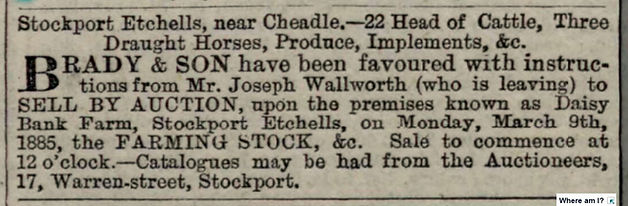
Fig. 5 Daisy Bank Farm sale
Manchester Courier 07 March 1885
Click On Image To View
Did he leave Martha and his children to go out first and set up a new life and would then call for them? With the farm sold, did she return to her parents at Chamber Hall?
Joseph started working for the Canadian Pacific Railway Company, rather than as a farmer over there. Sadly, whatever his plans were, he was killed on December 29th, 1888, at work.
An inquest was held to establish the facts. It seems that Joseph had been employed for several years and although an experienced foreman had been caught up in a dynamite explosion. His residence was still noted as Daisy Bank, so had the farm not sold by then?


Figs. 6, 7, 8, 9A and 9B Joseph Wallworth's inquest
Toronto Daily Mail 1st January 1889
Click On Image To View


What an awful, devastating year 1888 would have been for Martha. Not only losing her husband but also her father. This left herself and her mother Hannah widows. Was Daisy Bank then sold so the family had to move out?
On the 1891 census, in Northen Etchells, Martha and her mother were now living not at either Daisy Bank or Chamber Hall, but somewhere in Moss Nook between the Tatton Arms pub and Heald Green House, at this time a lunatic asylum, on the old Styal Road.
Hannah Simpson was 71 and Martha was 42. They lived with a general servant, 49 year old Mary Ann Tipping. On August 30th, 1900, Mary Chesters Wallworth married John Ernest Briscall. Her marriage certificate had her address as 4 Massie Street, Cheadle.
In Stockport Etchells “Daisy Bank Farm” was noted on the census for the first time and was now home to the Kelsall family. James aged 36 was the farm bailiff. He lived with his wife Mary who was 38 and their children. David at 14 years of age was already an agricultural labourer. Mary was 9, Annie 6, Sarah 4 and William 2. They lived with two lodgers. Edward Rose aged 27 and Walter Gatley aged 22, they were both agricultural labourers.
Daisy Bank Farm was not named on the 1901 census. I believe the Price family were there. John aged 37 was a waggoner on the farm and he lived there with his wife, 38 year old Francis and their six children. Frank aged 17 was an agricultural labourer. Mary aged 16, Elenor 12, John 10 (he would go on to farm at Oak Farm, where Roseacre Drive is, by 1921), Alice 6 and Francis 3.
In 1903, farmer Allan Gardiner married Emily Gradwell. They were both from Styal farming families. By 1907 they were living at Daisy Bank.


Fig. 11 Heald Green listing
Slaters Directory 1909
Click On Image To View
On the 1911 census, Allan aged 39 lived with Emily aged 37 and their two sons. Harold Bruckshaw aged 7 and Alan Grenville 1. They had two servants, John Robinson a 53 year old cowman and 17 year old Henry Woodbridge a waggoner. Eight rooms were counted at the farmhouse.
By 1921 they had a daughter, Mary Mildred age 9 and both her and brother Alan were at school “whole time”. Sadly, son Harold born in 1903, died 8th December 1918. More sadness falling on a family, such were the times back then.
They still had two servants. Lily Ferns a 21 year old domestic servant from Surrey and 16 year old Albert Oldham was doing general farm work. Seven rooms were counted on this census.
Allan Gardiner died in 1934 by which time the Grundey family had taken over. Grenville went on to farm at Oak Farm in Styal.
Fig. 12 Daisy Bank Farm jobs
Sheffield Daily Telegraph 28.4.1930
Click On Image To View


Fig. 13 Daisy Bank Farm job
Sheffield Daily Telegraph 19.5.1939
Click On Image To View
On the 1939 register William Grundey aged 48 was the farmer and classed as a heavy worker. Wife Violet aged 42, did unpaid domestic duties, but lots of the farming by all accounts. Son William aged 12 was at school. The farm employed Roy England aged 18, as a farm labourer and heavy worker and 18 year old dairy maid Mary Wincott.
“My father in law, Roy England, came over from Yorkshire when he about 14 years old, following his older sister who was in service in Handforth (he didn’t want to work down the mines). So, he was born in 1921. He was in Italy during WW11 and I have some medals from his service. My husband recalls the family. He said they used to call on them when he was a young lad, when Mr Grundy used to be getting ready to go to the Heald Green pub to have a few drinks. Roy became the local milkman at Healds Dairy, not sure when he joined there.”
- Christine England, Messenger 2026
4
The family and the farm did its bit for King and country in WW11. With Atlantic convoys being destroyed on a daily basis by the Germans, it was imperative that every bit of land could be utilised for growing food. In 1941 the Americans sent seed and this was distributed from a shed at the farm.
Local evacuees, having never seen food being grown in a field, helped out with potato picking, for which they received pocket money. As well as growing potatoes the family also produced milk, both of which they sold at their front gate.
After WW11, with what was now surplus to requirements, aeroplane propellors were used by farmers and residents as boundary fences.
5
6
“I have it in my mind that as a toddler going to the village from Motcombe Road, we used to go past what was the farm opposite the Heald Green Hotel. It had aeroplane propellor blades in the fence at the front. It may just be a figment of my imagination but every time I pass, I wonder if I'm just a daft old *** who's imagining it.”
- Chris Hamlet, Facebook 2024
“You could be right. My partner’s mum & dad ran Daisy Bank Farm. He said he remembers the propellers round the hay shed at Chamber Hall opposite (his grandparents farm) and he said they weren’t at Daisy Bank when he was there (1970-95) but could have been earlier.”
- Julia Taylor, Facebook 2024
In 1950 son William Grundey (Bill) got married.
“Bill Grundy was the father of son also called Bill who married Doreen Gatley from Moss Nook on 29 July 1950 at Northenden Church. He remarried in 1965 and had a son called Carl.”
- Helen Pike Facebook 2026
“I knew Hugh Bailey from Broadway 1953 onwards, he was at that time living at Chamber Hall Farm. Guess he must have taken the tenancy of Daisy Bank Farm post me leaving Heald Green. Around the 50/60's Daisy Bank was locally known as Grundy’s. Baileys Farm was down the Lane next to Appletons ... Williams Farm was where Tedder Drive is, one of the lads was Billy. Grundys was on Finney Lane next to the Telephone Exchange (Mercury). Nixons is on Cross Road and still known as Nixons Farm, one of the lads I think Norman was at my school. Richardsons was at Bradshaw Hall.”
- Michael Richardson, Facebook 2021
The Kelsalls may have been back at the farm in 1954.

Fig. 14 Daisy Bank Farm Kelsalls reference from 1954
© British Newspaper Archive
Click On Image To View
The Bayley family, note the spelling, took over the tenancy from the Grundeys in 1970 and after renovations moved in in 1973. Rent was paid to Manchester council.
Fig. 15 Daisy Bank Farm early 1970s prior to the refurb
© Bayley family
Click On Image To View

The Bayleys are related to the Simpsons at Chamber Hall. Mary Hannah Simpson born 1872, married William Pimlott and they had children John in 1908, Winifred in 1910 and Florence in 1913.
Florence married Samuel Bayley born 1910. They had two children, Christine in 1939 and Hugh in 1943.
Florence’s Uncle Joseph was a Simpson. He and his wife had no children. He ran Chamber Hall Farm and when he died in 1962, his niece Florence and Samuel took over the farm.
Hugh married Jean Redman. They lived at 8 Outwood Drive before moving to Daisy Bank Farm. Their children are Sarah, Robert and Samantha. Hugh continued to work in partnership with Samuel at Chamber Hall.

I love this photo. It’s after 1969, as the new Styal Road can be seen. Wythenshawe and Baguley hospitals were straight ahead. It reminds me of the film called The Plank with Eric Sykes and Tommy Cooper or a Ronnie Barker skit! Thank you to Alison Murray for upgrading the colour from the original photo posted on our Facebook group by Antony Pownall.
Fig. 16 Top of Daisy Bank farm
© Antony Pownall
Click On Image To View
Fig. 17 Daisy Bank Farm 1979
© Helen Morgan
Click On Image To View


In March 1981 Cheshire Life came to our village and featured the Bayleys amongst others.
Fig. 18 The Bayley family March 1981
© Cheshire Life
Click On Image To View
Having been in contact with Jean Bayley and her daughter Sarah, we now have an insight into how the farmhouse looked and their daily lives living there.
From Sarah Bayley, via email 2026.
“Daisy Bank Farm was let with a traditional red brick and stone roofed farmhouse in a local 18th Century style. In the 1970s, it was completely unmodernised with an outside toilet, no damp proof course and stone slabbed floors. There was a cobbled yard, traditional buildings and about 60 acres: paddock, Backside Field by the house and Long Hey and part of Front Meadow on the south side of Finney Lane running next to the railway station.
To the east of the house was a long redbrick and stone roofed building that was split into four stables with lofts above and a double height hayshed in the middle. Across the cobbled yard was a long brick shed that had been cow cubicles in the time of Bill Grundy. There were two pigsties at the end. Above the pigsties was a pigeon loft with pigeonholes in the brick and stone slab perches on the outside. At the end of this block, was another outside privy, with a long wooden seat with a big hole and a smaller hole on a lower level leading to a ‘longdrop toilet’ for adults and kids.
To the west of the house was square dairy room that would have been used for making butter and cream, privy (outside toilet) then open sheds for storage of logs and machinery. North of that was a Dutch barn type hayshed. As kids we spent lots of time making ‘dens’ in the hayshed, as they were the small bales that could be moved by hand. If a load of hay or straw was brought from the fields it would have to be unloaded and stacked by hand (approx. 14 tonnes). If we were not about sometimes the poor wagon driver would have to unload it on his own.
Daisy Bank Farmhouse at that time had four bedrooms upstairs, but one was turned into an inside bathroom. Downstairs a scullery, kitchen, dining room, living room, pantry with stone flagged shelves and a cellar with stone steps and stone flag shelves partially underground. On one occasion the yard flooded in a storm and filled the cellar up to the top step with water. We were scared it was going to flood all the way into the house, but we managed to start pumping the water out in time.
The kitchen had stone flagged floors but was very damp, so bitumen was poured to make a new floor. The ceilings were very low, with woodworm eaten ceiling beams. In the kitchen the beams still had the meat hooks. Above the scullery was a room that could only be accessed by stone steps outside. Inside the house it was always drafty with a breeze under every internal door and all the floorboards squeaked.
The outside walls at the back of the house and inside walls were whitewashed with lime and horsehair. It was refreshed every now and again by mixing a big dolly tub full of lime and water and we got horsehair from Walter Slack’s Clydesdale horses. It was very difficult to mix never mind apply on the walls. The yard was mainly cobbles and setts and Hugh used to brush it clean every now and again but it would take most of the day to do it all and his arms must have been burning.
In the 1980s, changes were made to the farm. In the yard, a strip of concrete was laid in front of the buildings and two of the stables were changed to open fronted sheds to allow machinery to drive in.
One stable was used for livestock, then Dougal the Suffolk Punch/Welsh pony. The other stable was used for calf rearing where we hand reared dairy calves that would be reared to join the herd. The lofts were accessed by ladders or rickety wooden stairs and used for storage, either bales of hay or seed potatoes.
During the tenancy we added a big wooden hen house, then a silage clamp was built between the old cubicle shed and Backside Field. Poplar trees were planted at one end of the yard by the multi-storey GPO building directly adjacent to try to block the view a bit.
The land and buildings at Daisy Bank were farmed as part of the larger and adjacent Chamber Hall Farm. The farming enterprise was mainly dairy cows. We had about 180 Friesian cows and a beef bull and sold milk.
Many people were inconvenienced by the cows walking across Simonsway, twice a day, between the milking parlour and the grazing fields on the other side of the Reynold Chains factory. Most drivers and pedestrians were patient in waiting for the cows to cross, but some car drivers did try to force their way through and a few wing mirrors were lost! There may have been some mucky shoes too.
The cows generally knew where they were going. It was only a few young heifers, who sometimes decided to branch out to try all the fresh grass on the verges. The old cattle track can still be seen running along Styal Road from the traffic lights, although it is now overgrown and leads to airport carparking.”
I know many remember that daily occurrence and your memories will be added to an updated Chamber Hall article at some point and just to whet your appetite we may have moving pictures of it too. How fantastic would that be!
The calves were sold at Chelford Market at about a month old and some were kept on to rear for beef. We grew potatoes, made our own silage and hay and sometimes grew barley that we would roll/crush and feed to the cows. The fields at Daisy Bank were just used for grazing. We regularly rented extra land to either grow barley or for grazing for youngstock throughout the area such as Styal and Cheadle Royal (before it was redeveloped) or even as far as Adlington or Poynton.
Dry cows were kept in the long shed with access to the silage clamp during the winter. When the cows calved, they moved back to Chamber Hall where the milking parlour was located. The shed was bedded up with straw and only cleaned out in the spring. Sometimes the bedding rose two to three feet high, so the cows would look over the half-stable doors. When the shed was cleaned out, hordes of rats would run in every direction over the yard.
During Grundy’s tenancy, this shed was the cubicle house where cows would be tethered and milked. The brick pigsties were used for pigs for a short while. They had solid sandstone slab walls making an external enclosure with a brick archway on the building leading to a very low internal area, making it difficult to clean out. For a few years in the 1980’s they were used for pet rabbit enclosures and hutches.
Eggs and potatoes were sold at the door. Most customers walked in from Finney Lane, round the back and knocked on the door. We had trays of eggs, large or medium, which were sold by the dozen or the tray. We relied upon people bringing egg boxes back so sometimes we had to sell eggs in a plastic bag.
In the 1980s we invested in a potato harvesting machine. We grew potatoes in the land nearer the airport, harvested them, stored them covered in lots of straw in the big barn at Daisy Bank and then sorted them through a mechanised potato riddle where we could pick out lumps of mud or rotten potatoes, then they would be bagged up in 28 or 56 lb (25kg) bags. Most Saturday mornings were spent weighing out 5 lb bags or we would have to work on the potato harvester in the fields. As children we rode on the machine along Styal Road which may not be allowed now. Customers would come at any time of day or night, even Christmas day on occasion.
Hugh also took trailer loads of manure to the local allotments, especially in Sharston when the allotment holders all clubbed together to get some cow manure.
The farm was run as a family business with grandparents, parents, kids but also farm workers. William Williams from Moss Nook and Nigel Wright from Handforth worked on the farm from teenagers. William left a few years before we moved, but Nigel came with us to the new farm until he retired.
Daisy Bank is under the airport flightpath. When new animals were introduced, especially horses, the first time the planes went over head caused them to panic and race about. They then got used to it.
The children went to Bolshaw Primary School then respectively Kingsway and Broadway in Cheadle and St. Hilary’s in Alderley Edge. Our school friends often said that we were so lucky to live on a farm and could feed the animals and run free over 250 acres but we were also grateful that the farm was on the edge of a town and we had all the amenities of Manchester and Stockport with a bus stop outside the house (although passengers on the top deck were always looking through into our windows).”
This is the old dairy as well as the open sided machinery sheds. The old privy was behind the logs.
Looks like Hugh has just nipped inside for breakfast or lunch, leaving his wellies outside.
Fig. 19 Daisy Bank Farm back door and old dairy
© Bayley family
Click On Image To View


Jean had driven this load of straw back from near rented fields on the other side of Manchester airport. The long shed at the side was used for cattle. The telephone exchange is in the background.
Fig. 20 Jean on a 1750 John Deere tractor mid 1980s
© Bayley family
Click On Image To View
“Derek’s Mum used to clean Daisy Bank Farm for a Mrs Bayley who was lovely according to her. As well as wages she also was given eggs. These she passed on to us and her other children. Many’s the time we would turn up to someone’s house with half a dozen eggs. I wouldn’t be surprised if that included you, Helen, at least once. The Bayley family were there for a while. The son, his wife and children lived on the Finney Lane part and old Mr Bayley lived on Styal Road just before Appletons.”
- Diane Mills, Facebook 2026
Sarah Bayley continues, via email in 2026.
“The Bayleys left in 1995 as the Manchester Council wanted to take much of Chamber Hall land to extend car parking and create light industrial units, as part of Manchester Airport's continued development. Taking this land under compulsory purchase would make the farm business unviable, so a negotiation was reached to relinquish the tenancy. As the farming enterprise included Chamber Hall and Daisy Bank, this meant the Bayley family had to leave both, but it was very much against the wishes of the family who had occupied Daisy Bank for 25 years but Chamber Hall for more than 250 years. We are still dairy farming but now in west Dorset.”
That is why both farms went up for sale at the same time.
Florence Bayley died in 1994, Samuel Bayley in 2008 and Hugh more recently in 2022.
This photo is of moving day in 1995 with Samuel watching on. That day 180 cows and farm machinery from both farms were taken to the new one in West Dorset. The stables and loose housing can be seen. After milking, all the cows were loaded into double decker wagons, driven down the M6, unloaded and milked again seven hours later.
What a logistic operation that was!
Fig. 21 Moving day 1995
© Bayley family
Click On Image To View


Fig. 22 Chamber Hall and Daisy Bank sale
Wilmslow Express Advertiser 9.3.1995
Click On Image To View
In March 1999 a planning application was sent to SMBC by Mr PA Thorne and Miss R Uttley to relocate the hen coop. This was granted as long as the timber and corrugated metal sheets were painted dark green.
In June 1999 permission was refused to change the use of the outbuildings and erect a single storey extension and single storey building to form kennels for 40 dogs with construction of vehicular access to Finney Lane. The reasons given were the fact that it was an inappropriate development on green belt land and that the noise disturbance and nuisance would be detrimental to residential and office premises.
So, in 1999 the land was classed as green belt.

Fig. 23 By April 2009 Daisy Bank Farm was a boarding kennels business
© Google Maps
Click On Image To View
“Daisy Bank Farm is still there, and it was a working farm - many a day we had cows and sheep in our garden!! It is now used for horses and is a boarding kennels.”
- Christine England, Facebook 2024
In February 2013, Miss R Uttley was granted permission to replace the existing haybarn with a new one. The application stated that the barn was needed to house hay, straw, trailer and crops produced from the land to feed livestock over the winter when grass supplies were low. On this application it said that the farm had been a pedigree Aberdeen Angus cattle breeder since 2001.

Fig. 24 From Brown Lane looking towards the telephone exchange 20.9.2026
© H Morgan
Click On Image To View

Fig. 25 From Daisy Bank Lane July 2022
© H Morgan
Click On Image To View

Fig. 26 From Daisy Bank Lane July 2022
© H Morgan
Click On Image To View

Fig. 27 Towards fields from Brown Lane 20.9.2026
© H Morgan
Click On Image To View
In 2026, on the announcement that the business was closing, developers moved in at the last minute to add the farm to the Stockport Local Plan. Apparently, the land is now grey belt and the developers at the public meeting could not say for definite if the farmhouse and its barn would be saved from demolition.
A precedent has already been set at Griffin Farm on Wilmslow Road, when that was all boarded up in the 1990s going to wrack and ruin and all its outbuildings were used for various car businesses. A wonderful job was done on its restoration and hopefully the developers will look at Daisy Bank farm with its “of historical interest” tag in a new light. We can only hope, wait and see ...

Fig. 28 Daisy Bank Farm notification of public consultation September 2026
Click On Image To View

Fig. 29 View from the Heald Green Hotel car park 20.9.2026
© H Morgan
Click On Image To View
So that is the story of this farm and the many families who have called it home. This was where Heald Green began and we must do all we can to retain its importance as part of our heritage. I will therefore leave the last word to Sarah Bayley (via email 2026).
“My family were once at Peel Hall Farm, which was a half-timbered house surrounded by a moat. The only thing left, after Manchester Corporation left it to disintegrate and be vandalised, is the moat. Another part of the family was at Newall Green Farm, which was listed, and is still there today, surrounded by housing developments.
Daisy Bank has been lived in and used and adapted and modernised and refurbished.
The point I would like made is that Peel Hall, Newall Green, Daisy Bank Farm and Chamber Hall Farm are the last remnants of a whole farming based community and way of life that existed for hundreds of years. In this area there are of course modern demands, which we have to accept, but obliterating the hundreds of years of a way of life does not help modern society.
Thirty years have passed since they were working farms, even then surrounded on all sides by housing. There were people then in the area who could see greenery, see farming practices, see animals; on a regular basis. Local people were proud that they lived in an area close to farms, they were able to buy potatoes grown within a few miles from their house, local eggs, raw milk.
There may be no greenery left, but the existing farmhouse and buildings can still stand for something. At one time everyone was a farmer, then some were farmers, now no-one even knows a farmer! I think this part of our culture and heritage should at least be there for people to know that they still live in an interesting and diverse and cultural area. Historic buildings, next to a housing development anyway, add value to the modern buildings.”
A huge thank you to Sarah and Jean Bayley for their invaluable contribution to tell us about their lives at the farm.
Also, my thanks go to Stuart Hobson for his input into the Royle farming family and Peter Stanton Davies, my lovely go to map man.
Bibliography
-
Heinekey, J, (1996) Heald Green in Wartime, pp.52
-
Wikipedia
-
CanadaHistory.com
-
Heinekey, J, (1996) Heald Green in Wartime, pp.36
-
Heinekey, J, (1996) Heald Green in Wartime, pp.22
-
Heinekey, J, (1996) Heald Green in Wartime, pp.52
Search Our Museum Library (Google Drive account users only)
Timeline
Can You Help Us Improve The Museum?
-
Do you have any related personal memories, photos or documents that you can share with us on this topic?
-
Are any of our facts incorrect?
-
Contact us at healdgreenheritage@gmail.com, or via our Heald Green Heritage Facebook Page.
bottom of page